
Get involved!
Help us expand the Workers Control Archive!
If you think you have some interesting text or content is missing:
Get in contact ›››
Recommended articles
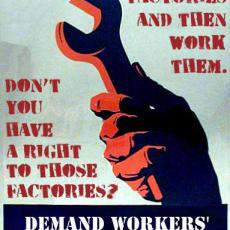 In regard to workplace occupations, the decision relates to workers’ assessments of their situation and their expectations about whether this will bring useful leverage.
|
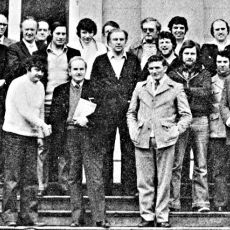 Hilary Wainwright reflects on an attempt by British workers to produce a democratically determined alternative plan for their industry.
|
 Human alienation will disappear through the withering away of commodity production and social division of labour, through the disappearance of private ownership of the means of production.
|
 When a factory in Thessaloniki was abandoned by its owners in May 2011, the workers decided to occupy it and resume production under workers’ control.
|
 Some currents argue that the experience of small-scale self-management under capitalism is useful preparation. However, self-management is impossible without real socialist democracy.
|